Feline Breeds (Scottish Fold, British, Persian, Domestic) & Clinical Health Questions
Cats naturally mask pain and early illness. Joint monitoring in Scottish Folds, cardiac (HCM) screening in British Shorthairs and Maine Coons, tear-duct and renal (PKD) care in Persians, alongside FIP, urethral obstruction (FLUTD), neutering and core vaccination protocols form the pillars of feline preventive medicine.
- Breed-specific orthopedic, cardiac (HCM) and renal (PKD) screening for Scottish Fold, British and Persian cats
- Straining in the litter box or blocked urination (FLUTD) in male cats: immediate 24-hour clinical emergency
- Routine 2–3 month parasite control and annual core boosters even for strictly indoor cats
1How is joint stiffness, limping and tail thickening (Osteochondrodysplasia) managed in Scottish Fold cats?
The genetic mutation responsible for folded ears in Scottish Folds affects cartilage and bone development throughout the body, predisposing them to Osteochondrodysplasia. Early signs include a stiff thickened tail, reluctance to jump and swollen paws. Fold-to-Fold breeding must strictly be avoided; affected cats benefit from weight management, digital radiographic monitoring and veterinarian-guided chondroprotective supplements (glucosamine, chondroitin and Omega-3 fatty acids).
2Why is screening for occult heart disease (HCM) vital in British Shorthair, Scottish and Maine Coon cats before anaesthesia?
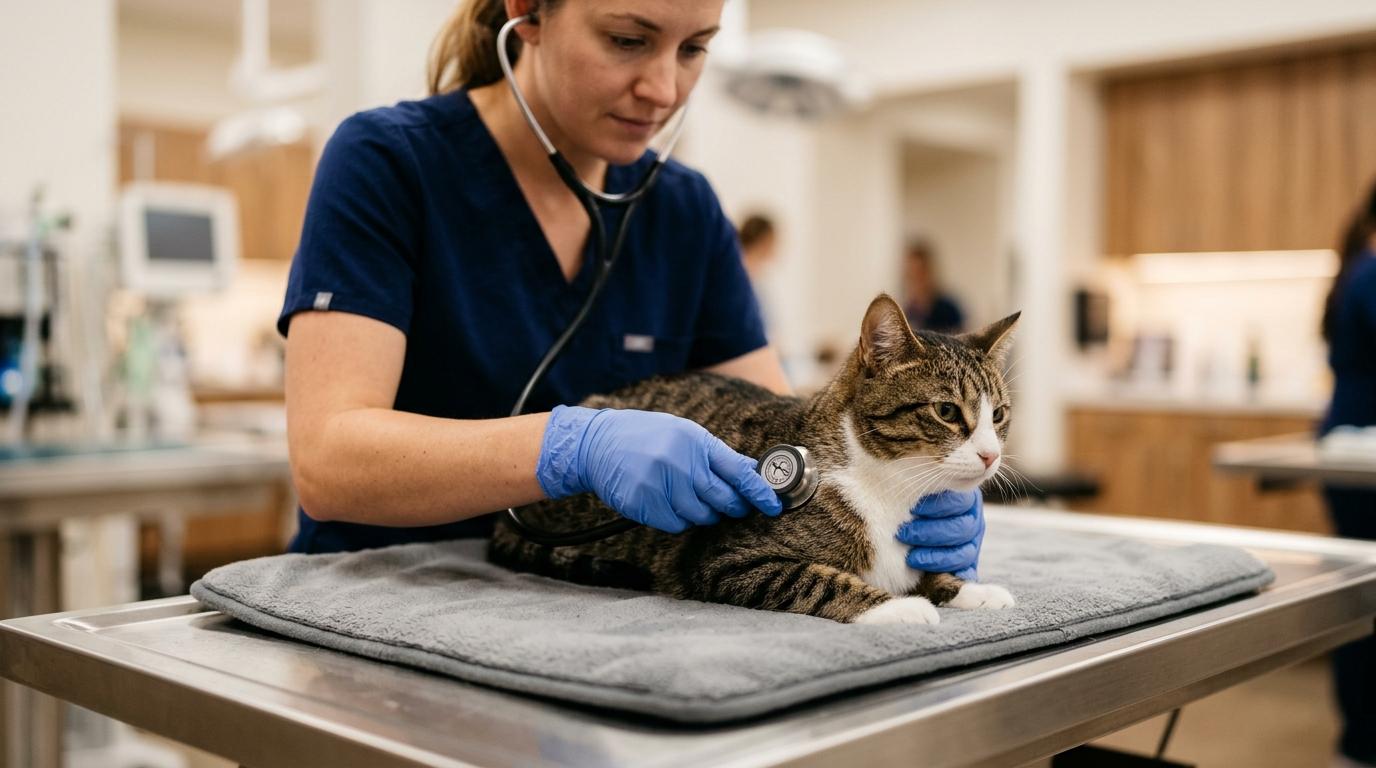
British Shorthair, Scottish Straight/Fold, Ragdoll and Maine Coon breeds carry a genetic predisposition to Hypertrophic Cardiomyopathy (HCM—thickening of the heart muscle wall). Because many cats remain asymptomatic until stressed or anaesthetised, pre-operative cardiac auscultation, blood biochemistry screening and controlled gas (inhalation) anaesthesia are essential safety protocols at our clinic.
3How should tear staining, noisy breathing and Polycystic Kidney Disease (PKD) be managed in Persian, Exotic Shorthair and Chinchilla cats?
Brachycephalic (flat-faced) Persian, Exotic Shorthair and Chinchilla cats have shortened, curved tear ducts that cause tears to overflow onto the facial folds, requiring daily gentle cleansing with sterile ophthalmic solution. Because these breeds are also predisposed to hereditary Polycystic Kidney Disease (PKD), annual abdominal ultrasound screening and water intake monitoring are strongly recommended.
4My male cat keeps visiting the litter tray, straining and crying without passing urine (FLUTD)—why is this a 24-hour life-threatening emergency?
Male cats have a very narrow urethra that can become completely blocked by struvite/oxalate crystals or stress-induced mucus plugs. Within 24–48 hours of obstruction, potassium and uraemic toxins accumulate in the bloodstream, leading to acute kidney failure and cardiac arrest. Any cat straining in the tray or passing blood-tinged drops requires immediate clinical catheterisation and intravenous fluid therapy.
5What are the wet and dry form symptoms of FIP (Feline Infectious Peritonitis), and what do abdominal swelling or cloudy eyes mean?
FIP develops when common feline enteric coronavirus (FCoV) mutates within an individual cat under stress or weak immunity. The "wet (effusive) form" causes straw-coloured fluid accumulation in the abdomen or chest with laboured breathing, whereas the "dry (non-effusive) form" presents with persistent antibiotic-resistant fever, weight loss, ocular cloudiness (uveitis) and neurological unsteadiness. Early diagnosis relies on blood biochemistry (Albumin/Globulin ratio), ultrasound and effusion analysis.
6At what age should female and male cats be neutered, and can surgery be performed while a cat is in heat?
Feline neutering (spaying/ovariohysterectomy in females and castration in males) is ideally performed from 6 months of age. In female cats during active oestrus (heat), uterine blood vessels are engorged, so scheduling surgery shortly after the heat cycle subsides minimises surgical bleeding. Neutering prevents pyometra (uterine infection), reduces mammary tumour risk and stops roaming or high-rise falls.
7What is the vaccination schedule for kittens and adult cats (Core Tricat, FeLV Leukemia and Rabies)?
Following initial parasite treatment, kittens receive their first Core Tricat vaccine (Panleukopenia, Herpesvirus and Calicivirus) at 6–8 weeks of age, with a booster 21 days later. This is followed by two doses of Feline Leukemia (FeLV) vaccine and the mandatory Rabies vaccine from 12 weeks of age. Adult cats receive annual single-dose boosters to maintain continuous immunity.
8Why do strictly indoor cats still need regular internal and external parasite prevention?
Fleas, tapeworm segments and roundworm eggs easily enter apartments on shoe soles, clothing, grocery bags and insects flying through windows. Because certain internal parasites such as Echinococcus carry zoonotic risk for humans, indoor cats should receive veterinary internal and external parasite treatments every 2 to 3 months year-round.
9How are bad breath, drooling and red inflamed gums (Stomatitis / Gingivitis / FORL) treated in Siamese and domestic cats?
Crying out while eating, dropping food, pawing at the mouth, drooling and halitosis point to periodontal tartar, immune-mediated chronic gingivostomatitis or Feline Odontoclastic Resorptive Lesions (FORL). Ultrasonic scaling, polishing and targeted dental care under safe gas anaesthesia restore pain-free eating.
10How can excessive shedding, circular bald patches (Ringworm / Dermatophytosis) and hairball vomiting be prevented in cats?
While seasonal shedding improves with daily brushing and Omega-3/Biotin supplementation, circular scaly hairless patches on the ears, face or paws typically indicate fungal ringworm (Microsporum canis) or mites and require clinical dermatological diagnosis. Giving feline malt paste 3–4 times a week prevents ingested hair from forming gastric hairball obstructions (trichobezoars).
11Why are white-coated breeds such as Turkish Angora and Van cats prone to ear-tip sores and sun sensitivity?
White cats lack protective melanin pigment on their ear tips and nasal planum, making the skin highly vulnerable to ultraviolet radiation. Prolonged sunbathing by windows can lead to redness, crusting and actinic dermatitis on the ear margins, which requires sun protection and early dermatological care. Blue-eyed white cats should also be evaluated for congenital hearing sensitivity.
12How are crusted shut eyes, sneezing and nasal discharge (Feline Herpesvirus / Calicivirus) treated in rescued kittens?
Mucopurulent eye crusts, sneezing and congested breathing in kittens are classic signs of Feline Upper Respiratory Infection (FHV-1 and Calicivirus). Never force crusted eyelids open dry; soften them gently with warm sterile saline and seek prompt veterinary ophthalmic drops, L-lysine support and nebulisation before corneal ulcers develop.
13Why are emergency X-rays and ultrasound mandatory after a balcony or window fall (High-Rise Syndrome) even if there is no external bleeding?
Cats falling from heights frequently sustain concealed internal injuries—including pulmonary contusion, pneumothorax (air in the chest cavity), diaphragmatic hernia, cleft palate and urinary bladder rupture—without obvious skin wounds. Immediate thoracic/abdominal radiographs, FAST ultrasound and oxygen stabilisation during the first 24 hours are life-saving.
14How are increased thirst, frequent urination and weight loss (Chronic Kidney Disease & Diabetes) detected early in cats over 7 years old?
In senior cats, drinking more water, larger urine clumps in the litter box, weight loss despite good appetite or uraemic breath are early indicators of Chronic Kidney Disease (CKD), Diabetes Mellitus or Hyperthyroidism. Biannual senior blood panels (Creatinine, BUN, SDMA, Glucose), urinalysis and renal-supportive nutrition significantly extend healthy lifespan.
15How long does feline pregnancy last, when can kittens be seen on ultrasound, and what are the signs of difficult birth (Dystocia)?
Feline gestation averages 63–65 days. Abdominal ultrasound confirms pregnancy sacs and foetal heartbeats from days 21–25, while digital X-rays after day 45 accurately count foetal skeletons. Strong straining for over an hour without delivery, or dark green/bloody discharge without a kitten, requires immediate veterinary examination and potential Caesarean section.